Table of Contents
ToggleNothing stops a kitchen in its tracks like a blinking error code on a supposedly smart appliance. The E1 F9 error (sometimes displayed as F9 E1 or E1F9) on a Maytag dishwasher is one of the more common faults homeowners encounter, and it’s usually tied to a drainage or heating issue. The good news? Most causes are straightforward and can be tackled with basic tools and a little patience. Before calling a technician or resigning yourself to washing dishes by hand, it’s worth walking through a few systematic checks. This guide covers what triggers the error, how to troubleshoot it step by step, and when it’s time to hand the job over to a pro.
Key Takeaways
- The Maytag dishwasher E1 F9 error typically signals a drainage problem or stuck relay, most often caused by a clogged filter, kinked hose, or failed drain pump.
- Start troubleshooting with a hard reset and check the drain filter and hose—these simple fixes resolve the majority of E1 F9 errors without professional help.
- The garbage disposal knockout plug is a commonly overlooked culprit; if your dishwasher connects to a new disposal, verify this plastic disc has been removed from the inlet.
- If the drain system is clear but the error persists, test the drain pump with a multimeter for continuity; replacement pumps typically cost $60–$120 and can be swapped in 30–60 minutes.
- Call a professional technician if the error remains after clearing the drain and replacing the pump, if your dishwasher is under warranty, or if you’re uncomfortable working with household electrical components.
- Preventive maintenance—cleaning the filter regularly, scraping plates, and running hot water before cycles—significantly reduces the likelihood of drainage issues and error codes.
What Does the E1 F9 Error Code Mean on Your Maytag Dishwasher?
The E1 F9 error code on a Maytag dishwasher signals that the unit isn’t draining properly or the control board has detected a stuck relay. In most cases, it points to a drainage system fault, water remains in the tub after a cycle, triggering a safety cutoff to prevent flooding or motor damage. Less often, it can indicate an electrical relay issue on the main control board that thinks the drain pump is running continuously.
Maytag dishwashers rely on a recirculation pump and a separate drain pump. When the cycle ends, the drain pump should expel all standing water through the drain hose. If something blocks the flow, food debris, a kinked hose, or a failed pump, water sits in the tub, and the control board throws the maytag dishwasher f9 e1 error. Some models flash the code mid-cycle: others wait until the end and refuse to start a new load.
Understanding the logic helps narrow your troubleshooting. The machine isn’t guessing, it’s reading water-level sensors and motor feedback. If the sensor sees standing water or the board registers abnormal current draw from the drain pump, the E1 F9 code fires. This specificity makes diagnosis easier than a vague “won’t drain” complaint, so take the code seriously and work methodically through the potential causes.
Common Causes of the E1 F9 Error Code
Several culprits trigger the e1 f9 maytag dishwasher error. Knowing the usual suspects saves time and prevents unnecessary part swaps.
Clogged drain filter or sump: The filter basket at the bottom of the tub catches food particles. When it’s packed with debris, water can’t reach the drain pump. This is the single most common cause and takes five minutes to fix.
Blocked or kinked drain hose: The hose runs from the pump to your home’s drain line. A kink, sag, or buildup of grease and detergent residue restricts flow. Check the entire run, especially where the hose exits the cabinet or connects to a garbage disposal.
Garbage disposal plug not removed: If your dishwasher drain hose connects to a new garbage disposal, there’s a knockout plug inside the disposal inlet that must be punched out with a screwdriver and extracted. Leaving it in place blocks drainage completely and confuses many first-time installers.
Failed drain pump: Pumps wear out. Impellers crack, bearings seize, or windings burn out. If you hear humming but no water movement, or dead silence when the drain cycle should start, suspect the pump motor.
Stuck relay on control board: Occasionally the control board’s relay for the drain pump welds itself shut or fails open. The board misreads pump status and throws the E1 F9 code even though the drain system is clear. This is less common but worth testing if all mechanical checks pass.
Faulty wiring or connections: Corroded terminals, loose wire harnesses, or damaged insulation can interrupt signals between the pump and control board. Inspect connectors for moisture, oxidation, or burn marks.
Step-by-Step Troubleshooting Guide for E1 F9 Error
Work through these checks in order. Most E1 F9 errors resolve within the first two steps: the rest cover deeper dives.
Reset Your Maytag Dishwasher
Start with a hard reset to clear transient glitches. Unplug the dishwasher or flip its dedicated circuit breaker in your home’s electrical panel. Wait five full minutes, not thirty seconds, to let capacitors discharge and the control board reset fully. Restore power and run a rinse cycle.
If the e1f9 maytag dishwasher error clears and the cycle completes normally, the issue was a temporary software hiccup or relay stutter. Monitor the next few loads. If the code reappears, move to mechanical checks.
Some Maytag models offer a diagnostic mode accessed by pressing a specific button sequence (often Heated Dry + Normal four times within five seconds). Consult your owner’s manual. Diagnostic mode cycles components individually and can pinpoint whether the drain pump responds to commands.
Check and Clean the Drain System
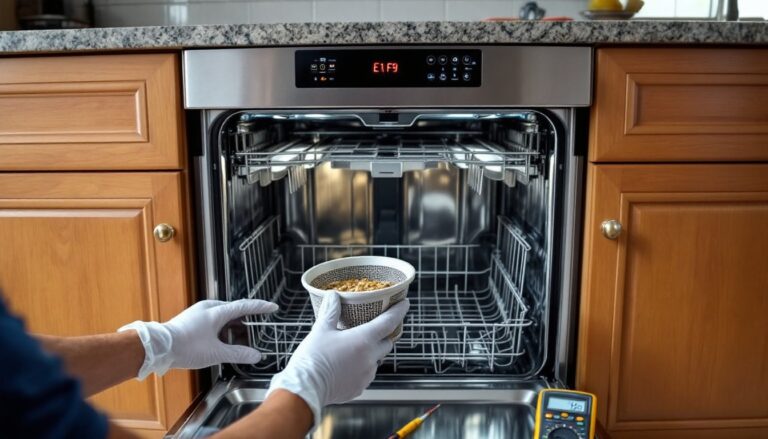
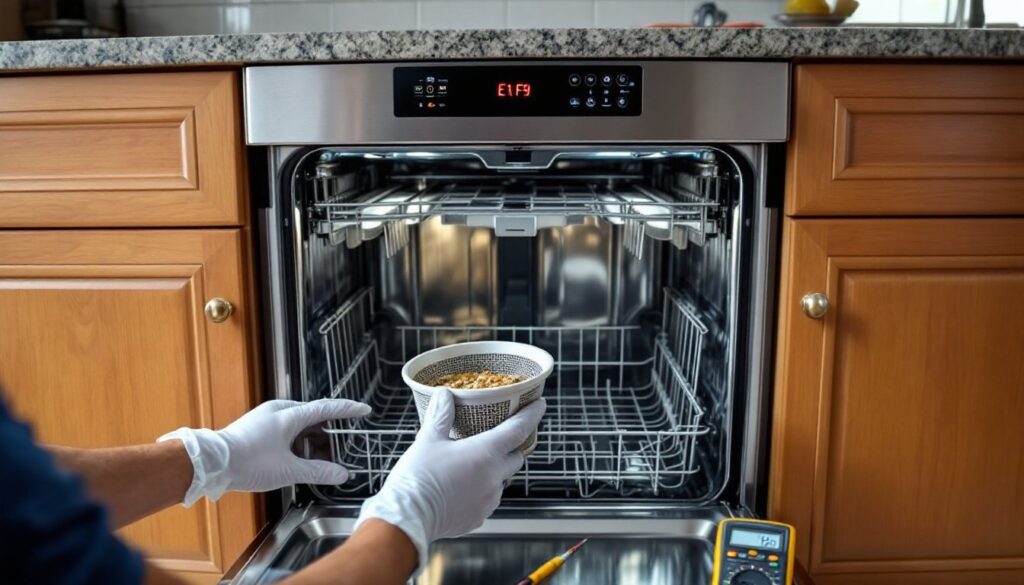
This is where most E1 F9 faults live. Open the dishwasher door and remove the lower dish rack. Twist and lift out the cylindrical filter assembly at the tub bottom. Rinse it under hot tap water, scrubbing away trapped food with an old toothbrush. Check the sump opening below the filter for standing water, bones, glass shards, or twist ties, anything solid.
Next, pull the dishwasher forward from under the counter to access the drain hose. You’ll need to remove the kick plate (usually two screws or spring clips) and disconnect the water supply. Trace the drain hose from the pump outlet to the sink drain or disposal. Look for kinks, sags below the pump outlet (which trap water), or a high loop that’s collapsed. The hose should rise to just below the countertop before descending into the drain line.
Detach the hose at both ends. Flush it with a garden hose outdoors or into a bucket. Grease, detergent buildup, and mineral scale can coat the inside. If the hose feels stiff or shows cracks, replace it with a ⅝-inch or ⅞-inch ID dishwasher drain hose (match your model’s spec).
If the hose connects to a garbage disposal, remove the hose clamp and peer into the disposal inlet. Shine a flashlight. If you see a solid plastic disc, that’s the knockout plug. Remove the disposal from the sink, knock the plug inward with a flat-head screwdriver and needle-nose pliers, then reinstall. This plug is the root cause of many “new dishwasher won’t drain” service calls and costs homeowners hundreds in unnecessary repairs when diagnosed as a failed pump.
Reassemble, run a test cycle, and check for standing water. If the tub drains completely and the error doesn’t return, you’re done.
Inspect the Drain Pump and Motor
If the drain path is clear but the maytag dishwasher f9 e1 error persists, test the drain pump. With the dishwasher pulled forward and powered off, locate the pump under the tub. It’s a black or gray cylindrical motor with inlet and outlet ports, secured by screws or twist-lock tabs.
Disconnect the wire harness. Use a multimeter set to ohms to test continuity across the pump’s terminals. Normal resistance ranges from 40 to 80 ohms depending on model: zero ohms means a short, infinite resistance means an open winding. Either condition requires pump replacement.
If resistance is normal, reconnect power and wiring, then manually start a drain cycle while listening. A loud hum with no water movement suggests a seized impeller or jammed rotor. Remove the pump (note the orientation of inlet and outlet), disassemble the volute cover (usually three screws), and inspect the impeller for cracks, missing blades, or obstructions like toothpicks or fruit pits. Clean and reassemble, or order a replacement pump assembly.
Maytag drain pumps typically cost $60–$120 and are available through appliance parts suppliers. Match your model number (found on the door jamb sticker) to ensure correct fitment. Replacement involves draining residual water, removing hose clamps, unscrewing the mounting bracket, and swapping the unit. Budget thirty to sixty minutes for the job if you’re methodical.
If the pump tests good and runs without obstruction, the fault likely lies with the control board relay. That repair crosses into professional territory unless you’re comfortable with circuit board diagnostics and soldering.
When to Call a Professional for E1 F9 Repairs
DIY troubleshooting has limits. Call a licensed appliance technician if:
You’ve cleared the drain system and replaced the pump, but the error persists. The issue is likely a failed control board, wiring harness fault, or pressure sensor. Boards run $200–$400 plus labor, and misdiagnosis is expensive.
The dishwasher is under warranty. Attempting repairs yourself may void coverage. Maytag’s limited warranty typically covers parts and labor for one year. Extended warranties or service plans often require authorized service.
You’re uncomfortable working with 120V household current. Appliance repair involves live electrical connections if you’re testing components under power. If you’re not confident de-energizing circuits and using a multimeter safely, hire out.
Your municipality requires permits for appliance work. Some jurisdictions mandate licensed contractors for any hardwired appliance modification. Check local codes.
Typical service-call pricing varies by region, but expect $150–$250 for diagnosis plus parts and labor. Compare that to a new mid-range dishwasher ($500–$800 installed). If your unit is over eight years old, multiple components are failing, or the cabinet shows rust and leaks, replacement may be more economical than repair. Discuss options with the technician before authorizing work.
For additional context on Maytag error codes and their meanings, manufacturers and appliance-repair forums provide model-specific flowcharts and part numbers. Cross-reference your findings before ordering parts. And remember: dishwashers aren’t kitchen centerpieces, they’re workhorses. Keep the filter clean, scrape plates before loading, and run hot water at the sink before starting a cycle to prime the inlet. A little maintenance forestalls most error codes and keeps your machine running for a decade or more.