Table of Contents
ToggleIf your fridge’s water tastes like chlorine or the ice cubes have a funky smell, the culprit’s probably a worn-out filter, or no filter at all. EveryDrop refrigerator filters are designed to pull out contaminants like lead, chlorine, and pharmaceuticals before they reach your glass. Unlike generic knock-offs that may skip third-party testing, EveryDrop filters are NSF-certified and engineered to fit Whirlpool, Maytag, KitchenAid, and other major brands. This guide walks through what makes an EveryDrop filter worth the investment, how to pick the right model for your fridge, and how to install and maintain it without calling a service tech.
Key Takeaways
- EveryDrop refrigerator filters use NSF-certified activated carbon to remove contaminants like lead, chlorine, and pharmaceuticals from your drinking water and ice.
- Choose the correct EveryDrop filter model for your fridge by locating your current filter number (such as EDR1RXD1 or EDR2RXD1) to ensure proper fit and prevent leaks.
- Replace your EveryDrop filter every six months or after 200 gallons of use—whichever comes first—to maintain filtration efficiency and prevent channeling of trapped contaminants.
- Installation takes about five minutes: remove the old filter, insert the new cartridge, and flush two gallons of water to purge air and carbon fines before using.
- Low water flow, leaks, and cloudy water are common installation issues easily resolved by purging air, inspecting the O-ring, and verifying the correct filter model matches your refrigerator.
What Is an EveryDrop Refrigerator Filter?
An EveryDrop refrigerator filter is a water filtration cartridge that installs inside compatible refrigerator models to reduce contaminants in drinking water and ice. Originally developed by Whirlpool Corporation, EveryDrop filters use activated carbon and other media to trap impurities as water flows through the refrigerator’s dispenser system.
Key features:
- NSF-certified filtration: Most EveryDrop models are certified to NSF/ANSI Standard 42 (aesthetic effects like chlorine taste) and Standard 53 (health effects like lead and cyst reduction).
- Compatibility: Designed for Whirlpool, Maytag, KitchenAid, Amana, and Jenn-Air refrigerators. Some models also fit LG, Samsung, and GE units, check your fridge’s filter number before ordering.
- Capacity: Rated to filter up to 200 gallons of water, or approximately six months of typical household use.
- Cartridge types: Available as twist-in, push-in, or inline filters depending on your refrigerator’s configuration.
The EveryDrop refrigerator water filter sits upstream of the water dispenser and ice maker, so every drop, hence the brand name, passes through the media before it reaches your glass or ice tray. If the homeowner skips replacement, flow rate drops and contaminant removal efficiency falls off sharply.
Why Your Refrigerator Needs a Quality Water Filter
Municipal water meets EPA standards, but that doesn’t mean it tastes great or is free of trace contaminants that slip through treatment plants. A quality EveryDrop refrigerator ice and water filter addresses both health and quality-of-life issues.
Health protection:
- Lead reduction: Older plumbing and service lines can leach lead into tap water. NSF 53-certified filters reduce lead to below federal action levels.
- Pharmaceutical traces: Prescription drugs, hormones, and over-the-counter medications show up in municipal supplies at low concentrations. Activated carbon captures many of these compounds.
- Microbial cysts: Giardia and Cryptosporidium cysts survive chlorination. Carbon-block filters rated for cyst reduction physically trap these parasites.
Taste and odor:
- Chlorine: Utilities add chlorine for disinfection, but it leaves a chemical aftertaste. Carbon adsorption removes chlorine molecules.
- Sediment and rust: Pipe scale and sediment cloud water and give ice an off-color. Pre-filters catch particulates down to a few microns.
- Sulfur compounds: In areas with well water or certain aquifers, hydrogen sulfide creates a rotten-egg smell. Specialized carbon blends neutralize sulfur.
Many homeowners following appliance maintenance schedules discover that replacing the filter improves ice clarity and extends the life of the ice maker by reducing mineral buildup. Skipping this step can lead to costly dispenser repairs down the line.
How to Choose the Right EveryDrop Filter for Your Fridge
EveryDrop offers multiple filter models, each engineered for specific refrigerator brands and internal plumbing layouts. Installing the wrong cartridge can cause leaks, poor flow, or no filtration at all.
Step 1: Locate your current filter number
Open the refrigerator door or lower grille and check the existing cartridge for a printed model number (e.g., EDR1RXD1, EDR2RXD1, EDR3RXD1). If the old filter is missing or unreadable, consult the owner’s manual or the nameplate inside the fridge compartment.
Step 2: Match to the EveryDrop equivalent
EveryDrop models replace OEM part numbers across multiple brands:
- Filter 1 (EDR1RXD1): Whirlpool, Maytag, KitchenAid, Amana side-by-side and bottom-freezer models. Twist-in design in the upper-right corner of the fresh-food compartment.
- Filter 2 (EDR2RXD1): Whirlpool, Maytag, KitchenAid French-door and side-by-side units. Push-button release in the base grille or upper-right interior.
- Filter 3 (EDR3RXD1): Whirlpool, Maytag side-by-side and top-freezer models. Twist-in cartridge in the upper-left or upper-right fresh-food section.
- Filter 4 (EDR4RXD1): Whirlpool side-by-side and bottom-freezer refrigerators. Located in the base grille with a push-button eject.
Step 3: Verify NSF certification
Look for the NSF mark on the packaging. Certified filters list specific contaminants they reduce, lead, chlorine, mercury, etc., and the percentage reduction. Generic filters may claim compatibility but lack independent lab verification.
Step 4: Consider water quality
If municipal reports show high sediment or the home has well water, pair the everydrop refrigerator filter with an upstream whole-house sediment pre-filter. This extends cartridge life by catching larger particles before they reach the fridge.
Step-by-Step Installation Guide for EveryDrop Filters
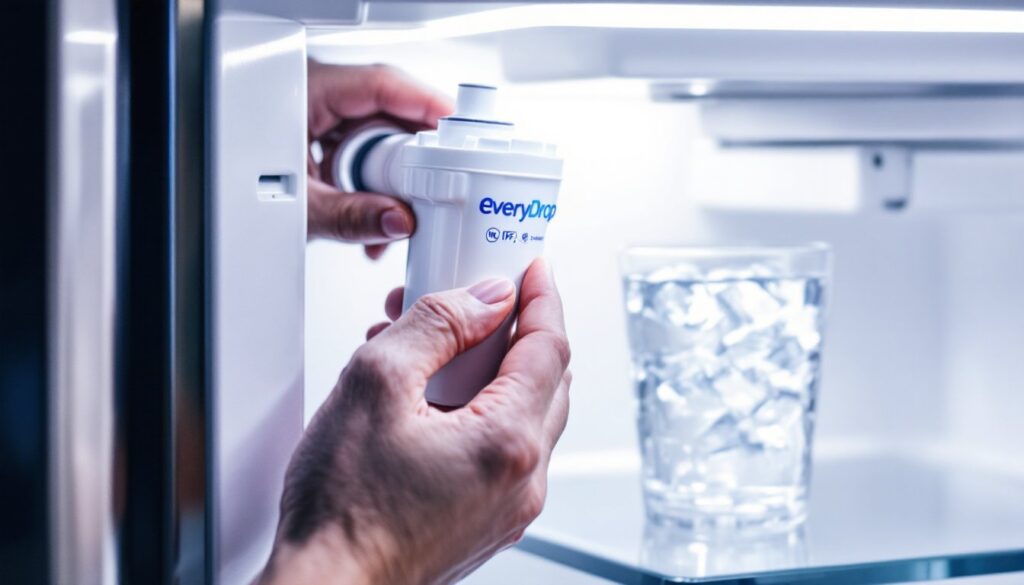
Replacing an everydrop refrigerator water filter takes about five minutes and requires no tools. Always shut off the ice maker and dispense a gallon of water after installation to flush carbon fines.
Tools and materials:
- New EveryDrop filter cartridge
- Clean towel or small container (to catch drips)
- Safety glasses (in case of trapped pressure release)
Installation steps:
- Locate the filter compartment. Most models place the cartridge in the upper-right corner of the fresh-food section or behind the base grille. Consult the owner’s manual if unsure.
- Remove the old filter. For twist-in models, turn the cartridge counterclockwise a quarter-turn and pull straight out. For push-button models, press the release button and slide the filter forward. Expect a few ounces of water to drip, catch it with a towel.
- Prepare the new filter. Remove protective caps from both ends. Some EveryDrop cartridges include O-rings pre-installed: do not remove them.
- Insert the new filter. Align the cartridge with the housing slots and push firmly. For twist-in models, rotate clockwise until it locks. For push-button models, slide until you hear a click.
- Flush the system. Run two gallons of water through the dispenser to purge air and carbon fines. Discard this water, it may be cloudy or gray from loose carbon particles.
- Reset the filter indicator. Most refrigerators have a filter-status light or LCD indicator. Press and hold the reset button (often labeled “Filter Reset” or “Alarm Reset”) for three seconds until the light turns green or the display clears.
Common mistakes:
- Forgetting to remove end caps: This blocks water flow entirely. Always double-check before insertion.
- Under-flushing: Skipping the two-gallon flush leaves carbon dust in the lines, clouding the first few batches of ice.
- Cross-threading twist-in filters: Force the cartridge and you’ll crack the housing. If it resists, pull out and realign.
Homeowners who follow tested appliance installation practices report fewer leaks and longer filter life. If water drips after installation, remove the cartridge, inspect the O-ring for damage, and reseat it.
How Often Should You Replace Your EveryDrop Filter?
Replace every six months or 200 gallons, whichever comes first. This interval is based on average household consumption, two to three people using the dispenser daily and running the ice maker.
Factors that shorten filter life:
- High sediment: Homes with older pipes or well water clog the media faster. If flow rate drops noticeably before the six-month mark, replace early.
- Large households: A family of five using the dispenser multiple times a day can hit 200 gallons in four months.
- Poor source water quality: Municipal systems with higher chlorine dosing or seasonal algae blooms load the carbon more quickly.
Signs it’s time to replace:
- Reduced flow rate: Water trickles instead of streaming, or ice production slows.
- Off taste or odor: Chlorine flavor returns, or ice smells musty.
- Filter indicator light: Most refrigerators with LCD panels flash a red or yellow light when the timer expires.
- Cloudy ice: Mineral buildup or microbial growth in a spent filter can cloud ice cubes.
Why six months, not twelve?
Activated carbon loses adsorption capacity as pores fill with contaminants. After 200 gallons, carbon is saturated and begins to release trapped compounds back into the water, a process called channeling. NSF testing confirms that filtration efficiency drops below certification thresholds past the rated lifespan.
Some kitchen maintenance guides recommend setting a phone reminder six months out from installation, since the filter indicator may fail or reset accidentally. Mark the installation date on the cartridge with a permanent marker as a backup.
Troubleshooting Common EveryDrop Filter Issues
Even correctly installed filters occasionally cause problems. Most issues trace back to air pockets, sediment buildup, or improper cartridge seating.
Problem: Low water flow or no ice production
- Cause: Air trapped in the line after installation, or the filter is clogged with sediment.
- Fix: Dispense two to three gallons of water to purge air. If flow remains slow, remove the filter and inspect for visible debris. Replace if clogged.
Problem: Water leaks from the filter housing
- Cause: Damaged O-ring, cross-threaded cartridge, or incorrect filter model.
- Fix: Remove the filter and examine the O-ring for cracks or displacement. Lubricate the O-ring with a drop of food-grade silicone grease and reseat the cartridge. If leaks persist, verify the filter model matches the fridge.
Problem: Cloudy or gray water after installation
- Cause: Carbon fines (harmless black particles) remain in the lines.
- Fix: This is normal. Flush an additional gallon through the dispenser. Cloudiness should clear within 24 hours.
Problem: Filter indicator won’t reset
- Cause: Button malfunction or the refrigerator’s control board didn’t register the reset command.
- Fix: Press and hold the reset button for five seconds. If the light stays red, unplug the refrigerator for 30 seconds to reboot the control board.
Problem: Metallic or plastic taste after replacing the filter
- Cause: Residual manufacturing oils or inadequate flushing.
- Fix: Run an additional gallon of water through the system. If the taste persists, remove the filter, soak it in cold water for 15 minutes, reinstall, and flush again.
When to call a pro:
If water pressure is low throughout the house, the issue may be upstream of the refrigerator, check the main shutoff valve and pressure regulator. If the refrigerator’s water inlet valve is frozen or clogged, replacement requires disconnecting the supply line and accessing the rear panel. This job involves shutting off the water supply and possibly pulling the fridge away from the wall, consider a service call if you’re not comfortable with plumbing connections.
Conclusion
Swapping out an EveryDrop filter every six months is one of the simplest ways to protect water quality and keep the refrigerator’s dispenser running smoothly. Match the filter model to the fridge, flush the system after installation, and mark the calendar for the next replacement. When the ice tastes clean and the water flows clear, the five-minute investment pays off every time someone fills a glass.