Table of Contents
ToggleIndoor air quality doesn’t fix itself. Dust, pollen, pet dander, mold spores, and volatile organic compounds (VOCs) circulate through the home constantly, settling into HVAC ducts, carpets, and curtains. Air purifiers help trap these contaminants before they’re inhaled, but only if the filter inside is up to the task. Understanding how these filters work, when to replace them, and which type fits a homeowner’s specific needs can mean the difference between breathing cleaner air and wasting money on a machine that’s barely functional.
Key Takeaways
- Air purifier filters work by trapping airborne particles through mechanical filtration, with effectiveness determined by MERV ratings, filter type, and material composition.
- HEPA filters capture 99.97% of particles at 0.3 microns and excel at removing allergens and smoke, while activated carbon filters specifically target gases, odors, and volatile organic compounds (VOCs).
- Choose an air purifier filter based on your primary contaminants—HEPA for allergies and dust, activated carbon for odors and chemicals—and ensure the unit’s CADR rating cycles your room’s air 4-5 times per hour.
- Replace HEPA filters every 6-12 months, activated carbon filters every 3-6 months, and monitor for reduced airflow, dust settling, or returned odors as signs that replacement is overdue.
- Extend filter life by cleaning washable pre-filters monthly, vacuuming exterior grilles weekly, running the unit on low continuously, and maintaining indoor humidity between 30-50%.
- Proper air purifier filter maintenance and timely replacement are essential to prevent airflow reduction, motor strain, and contaminant bypass that compromise indoor air quality.
What Is an Air Purifier Filter and How Does It Work?
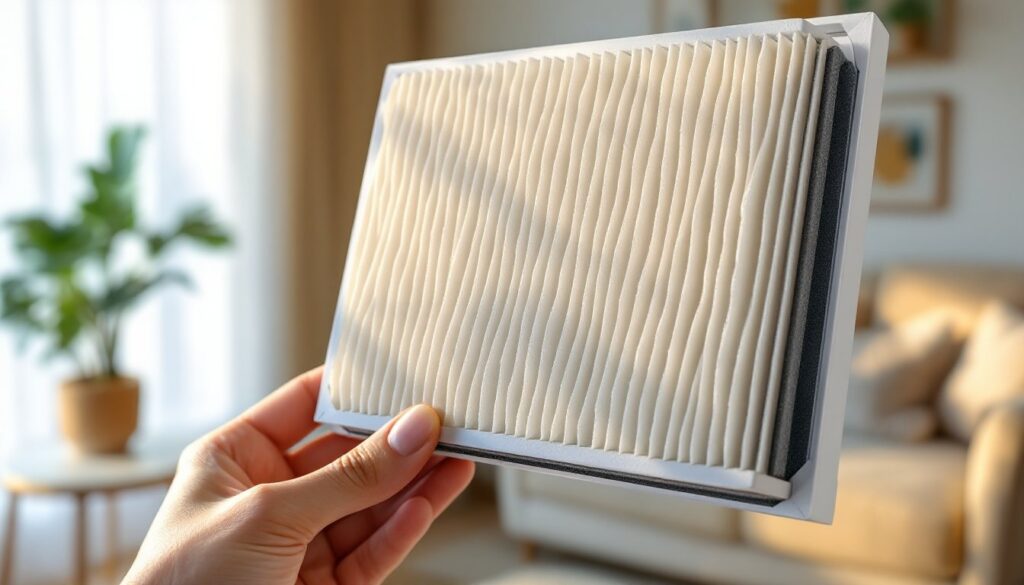
An air purifier filter is a porous material designed to capture airborne particles as air passes through it. The unit’s fan draws in room air, forcing it through one or more filter layers that trap contaminants based on particle size, chemical composition, or both. Clean air exits the other side and recirculates back into the room.
Most residential air purifiers use mechanical filtration, where particles physically stick to filter fibers. The filter media is typically made from fiberglass, synthetic polymers, or activated carbon, arranged in a dense mat or pleated sheet to maximize surface area. As particles collide with fibers, they adhere through diffusion, interception, or impaction, three mechanisms that become more effective as airflow slows and particle size decreases.
Some units add electrostatic charges to fibers, increasing their ability to attract particles like a magnet. Others use ultraviolet (UV) lights or ionizers alongside filters to neutralize bacteria and viruses, though these features don’t replace the need for a physical filter. The filter itself does the heavy lifting, and once it’s clogged with trapped contaminants, airflow drops and filtration efficiency plummets.
Understanding nominal versus actual filter ratings matters. A filter labeled “MERV 13” (Minimum Efficiency Reporting Value) captures at least 90% of particles between 3 and 10 microns, effective for pollen and mold spores, but not necessarily for smoke or ultrafine particles. Always check the manufacturer’s spec sheet for particle size ranges and efficiency percentages, not just marketing terms like “hospital-grade” or “99% effective.”
Types of Air Purifier Filters and Their Benefits
Not all filters handle the same contaminants. Choosing the wrong type means missing the pollutants causing problems in the first place.
HEPA Filters
True HEPA filters (High-Efficiency Particulate Air) meet a strict standard: they must capture at least 99.97% of particles 0.3 microns in diameter. This size represents the “most penetrating particle size” (MPPS), the hardest to trap, so HEPA filters also catch larger and smaller particles with even higher efficiency.
HEPA filtration works well for:
- Allergens: Pollen, pet dander, and dust mite debris
- Mold spores
- Fine dust and construction debris
- Smoke particles from wildfires or tobacco
HEPA filters don’t capture gases, odors, or VOCs. They’re purely mechanical, trapping solid and liquid particles. Expect to see fiberglass or synthetic fiber media folded into pleats to increase surface area without enlarging the unit’s footprint. Genuine HEPA filters cost more than generic “HEPA-type” filters, which may only capture 85-90% of particles at 0.3 microns.
Many smart home product reviews emphasize HEPA filtration as a baseline for allergy and asthma management, especially in bedrooms and living areas where people spend the most time.
Activated Carbon Filters
Activated carbon (also called activated charcoal) is treated to create millions of tiny pores, dramatically increasing surface area. One gram of activated carbon can have a surface area exceeding 500 square meters. This porous structure adsorbs gases and odors, meaning molecules stick to the carbon surface rather than passing through.
Activated carbon excels at removing:
- VOCs from paints, adhesives, and cleaning products
- Cooking odors and lingering smoke smells
- Chemical fumes from new furniture or carpets
- Pet odors
Carbon filters don’t trap particles: they capture molecular contaminants. Most air purifiers pair activated carbon with a HEPA filter to handle both particles and gases. Carbon filters saturate faster than HEPA filters because adsorption sites fill up and can’t be cleaned out, once saturated, the filter stops working and must be replaced.
Some units use a thin carbon pre-filter to extend HEPA life by catching larger particles and some odors before air reaches the primary filter. Thicker carbon filters (1-2 inches) provide better VOC removal but add resistance to airflow, requiring a more powerful fan.
How to Choose the Right Filter for Your Home
Filter selection depends on room size, primary contaminants, and how often the homeowner is willing to swap filters.
Step 1: Identify the contaminant. If allergies or pet dander are the issue, prioritize a true HEPA filter. If cooking smells, new paint, or chemical odors dominate, activated carbon is essential. Homes near wildfire zones or with smokers benefit from both.
Step 2: Match filter capacity to room size. Air purifiers list a Clean Air Delivery Rate (CADR) in cubic feet per minute (CFM) for smoke, dust, and pollen. For effective filtration, the unit should cycle the room’s air volume at least 4-5 times per hour. Calculate room volume (length × width × ceiling height), multiply by 5, then divide by 60 to get the minimum CADR needed. A 12′ × 15′ room with 8′ ceilings = 1,440 cubic feet. Multiply by 5 = 7,200 CFM per hour ÷ 60 minutes = 120 CFM minimum CADR.
Step 3: Check filter replacement cost and availability. Some manufacturers lock users into proprietary filters that cost $50-$100 each and need replacing every 3-6 months. Generic filters may fit but often lack the same filtration performance. When evaluating home appliances and tested recommendations, total cost of ownership over three years often reveals budget-friendly units that become expensive due to filter prices.
Step 4: Consider multi-stage filtration. Units with a pre-filter, HEPA filter, and activated carbon layer offer broader protection. Pre-filters (often washable mesh or foam) catch hair and large debris, extending HEPA and carbon life. Some models add UV-C lamps to kill bacteria and viruses, though the EPA notes UV effectiveness depends on exposure time and lamp intensity.
Step 5: Verify certifications. Look for AHAM (Association of Home Appliance Manufacturers) verification for CADR ratings and CARB (California Air Resources Board) certification if the unit uses ionization or ozone generation, some ionizers produce ozone as a byproduct, which irritates lungs and isn’t safe indoors.
When and How to Replace Your Air Purifier Filter
Filters don’t last forever. Waiting too long reduces airflow, overworks the fan motor, and lets contaminants bypass the clogged media.
Replacement intervals by filter type:
- Pre-filters (washable): Clean every 2-4 weeks: replace every 6-12 months if non-washable
- HEPA filters: Replace every 6-12 months depending on usage and air quality
- Activated carbon filters: Replace every 3-6 months: carbon saturates faster in homes with heavy cooking or VOC exposure
Signs a filter needs replacement:
- Reduced airflow from the unit even on high speed
- Increased dust settling on surfaces
- Return of odors the purifier previously eliminated
- Filter indicator light (if equipped) illuminates
- Visible dirt or discoloration on the filter surface
Many connected home device reviews highlight models with app-based filter monitoring that track hours of operation and air quality readings, sending replacement reminders when performance drops.
Replacement steps:
- Unplug the unit. Never open the filter compartment while the fan is running.
- Locate the filter access panel. Most residential units have a rear or side panel secured with clips or screws.
- Remove the old filter. Wear a disposable mask and gloves if allergies are a concern, the filter surface is covered in trapped contaminants.
- Check the filter housing. Vacuum out any dust or debris inside the compartment with a handheld vacuum.
- Install the new filter with the correct orientation. Arrows on the filter frame indicate airflow direction. Installing it backward reduces efficiency.
- Reset the filter indicator if the unit has one. Check the user manual for the reset procedure (often a button hold).
- Run the unit on high for 30 minutes to ensure proper airflow and check for unusual noises.
Dispose of used filters in sealed plastic bags. HEPA filters aren’t recyclable due to trapped contaminants, and carbon filters lose effectiveness once saturated.
DIY Maintenance Tips to Extend Filter Life
Regular upkeep stretches replacement intervals and keeps the unit running efficiently.
Clean the pre-filter monthly. If the unit has a washable pre-filter (usually foam or mesh), vacuum it with a brush attachment or rinse it under lukewarm water with mild dish soap. Let it air dry completely, 24 hours, before reinstalling. A damp pre-filter promotes mold growth.
Vacuum the exterior grilles. Dust and pet hair accumulate on intake and exhaust grilles, restricting airflow. Use a soft brush attachment on a vacuum once a week. If grilles are removable, wash them in the sink and dry thoroughly.
Run the purifier continuously on low. Constant operation is more effective than running it sporadically on high. A low-speed setting uses less energy and extends filter life by maintaining steady particle capture rather than sudden surges of dirty air.
Place the unit strategically. Position it at least 12 inches from walls and furniture to allow unobstructed airflow. Avoid placing it near curtains or in corners where air circulation is poor. Elevating the unit on a low table or stand improves intake from floor-level dust and pet dander.
Change HVAC filters regularly. Whole-house HVAC filters (usually MERV 8-13) trap larger particles before they circulate to rooms. Replacing these every 1-3 months reduces the load on portable air purifier filters.
Monitor humidity levels. Excess humidity (above 60%) encourages mold growth on filters. Use a hygrometer to track indoor humidity and run a dehumidifier in damp climates or during humid months. Keep humidity between 30-50% for optimal air quality and filter performance.
Avoid ozone generators and ionizers without HEPA backup. Some plug-in “air purifiers” generate ozone or ions without a physical filter. Ozone irritates lungs and doesn’t remove particles. If using an ionizer, pair it with a HEPA filter to trap charged particles that settle on surfaces.
Keep a replacement filter on hand. Ordering filters when the old one is already overdue means breathing dirtier air while waiting for delivery. Buy replacements in advance and store them in a cool, dry place in their original packaging to prevent dust buildup before installation.
Proper maintenance and timely replacement keep air purifiers effective. Filters are consumables, not optional upgrades, and treating them as routine maintenance, like HVAC filters or furnace servicing, ensures the unit delivers the air quality improvement it’s designed for.